
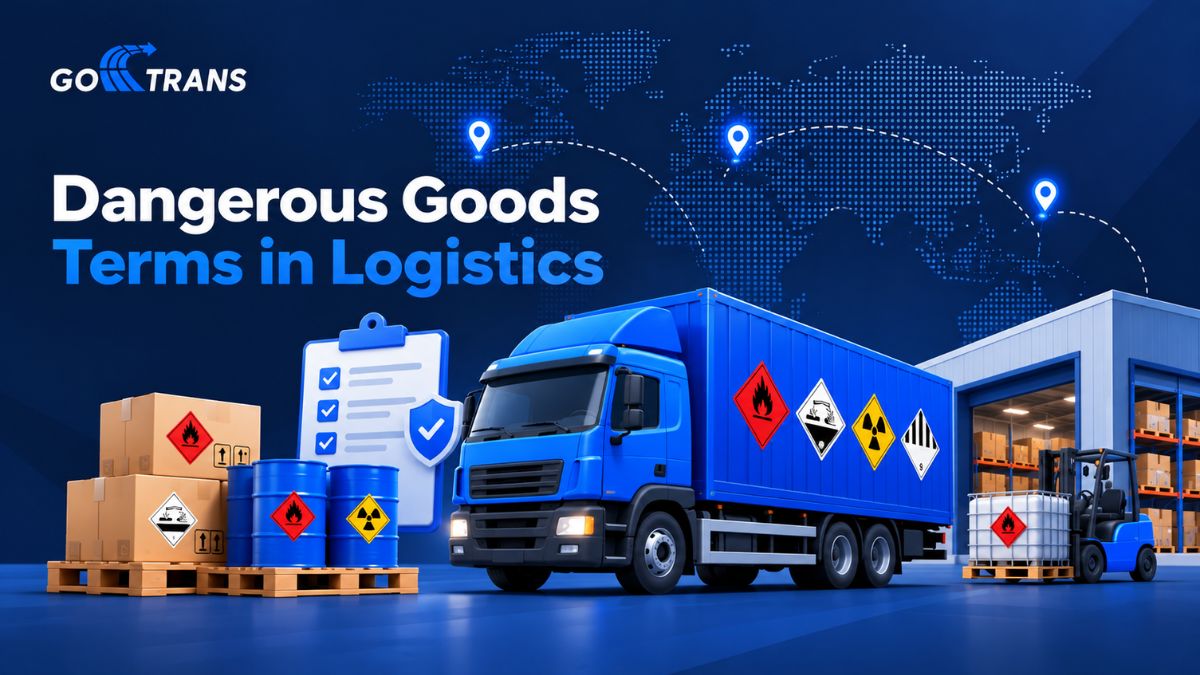
Dangerous goods terms in logistics are the rules, codes, markings and documents that control how hazardous substances move by road. Six terms cover the full chain, from ADR regulation to the orange plate on the vehicle. Each term answers a question the carrier asks before collection.
What Are Dangerous Goods in Road Transport?
Dangerous goods are substances and articles that create a risk to people, property or the environment during carriage. The UN system sorts them into 9 hazard classes:
- Class 1: explosives, such as fireworks
- Class 2: gases, such as aerosols
- Class 3: flammable liquids, such as petrol
- Class 4: flammable solids, such as matches
- Class 5: oxidising substances and organic peroxides, such as pool chlorine
- Class 6: toxic and infectious substances, such as pesticides
- Class 7: radioactive material, such as medical isotopes
- Class 8: corrosive substances, such as battery acid
- Class 9: miscellaneous dangerous goods, such as lithium batteries
Hazardous freight forms one of 8 subject clusters in the logistics glossary. The class a substance falls into decides which regulation applies next.
ADR: The Regulation Behind Dangerous Goods Transport
ADR is the European agreement that sets the rules for carrying dangerous goods by road. It is revised every 2 years and covers classification, packaging, labelling, transport documents, driver training and vehicle equipment.
A consignment moving under ADR transport needs a trained driver, a transport document and the correct vehicle marking. Every one of those requirements starts from a single identifier.
How Is a Dangerous Substance Identified?
A dangerous substance is identified by its UN number, a 4-digit code assigned by the United Nations. UN1203 identifies petrol, and UN3480 identifies lithium ion batteries shipped alone.
The UN number appears on the package label, the transport document and the orange plate of tank and bulk vehicles. The danger level inside the class is set by a second value.
What Does a Packing Group Show?
A packing group shows how dangerous a substance is within its hazard class: I for high danger, II for medium and III for low.
The packing group decides the strength of UN-approved packaging the goods need. The supplier publishes it in one document with the other transport values.
Which Document Holds the Transport Data?
The safety data sheet holds the transport data for a hazardous product. It is a 16-section document required under the EU REACH regulation, and section 14 lists the UN number, hazard class and packing group.
Those values, together with the quantity in each inner packaging, show whether a consignment qualifies for reduced rules.
When Do Reduced Rules Apply?
Reduced ADR rules apply to limited quantities, which are dangerous goods packed in small inner packagings below the limit set for each UN number. A limited quantity package weighs a maximum of 30 kg gross, or 20 kg for shrink-wrapped trays, and carries a black and white diamond mark.
These consignments need no ADR transport document and no ADR-certified driver. Vehicle marking still applies above 8 tonnes of limited quantity goods on a transport unit over 12 tonnes.
How Is a Dangerous Goods Vehicle Marked?
A dangerous goods vehicle is marked with orange plates at the front and rear, plus hazard placards on tanks and containers. The standard orange plate measures 400 × 300 mm.
Tank and bulk plates show the hazard identification number above the UN number, while packaged loads use plain orange plates. A numbered warning sign tells emergency services which substance the vehicle carries before they approach it.
How Do These Terms Work Together on a Booking?
A dangerous goods booking starts with the safety data sheet and ends with the vehicle marking. Section 14 supplies the UN number, class and packing group, and the limit set for that UN number in the ADR dangerous goods list decides between full ADR and limited quantity rules.
Go Trans arranges freight services across Europe for ADR consignments through carrier partners once those 3 values are declared at booking.
Get a Quote for Dangerous Goods Freight
Share the UN number, class, packing group and quantity to receive a confirmed price. Every quote includes the base rate, diesel surcharge and applicable tolls, with no charges added after booking.