
What Is a Box Body?
Explore box bodies, their construction, dimensions, cargo uses, securing systems, and advantages for protected European road freight transport operations.
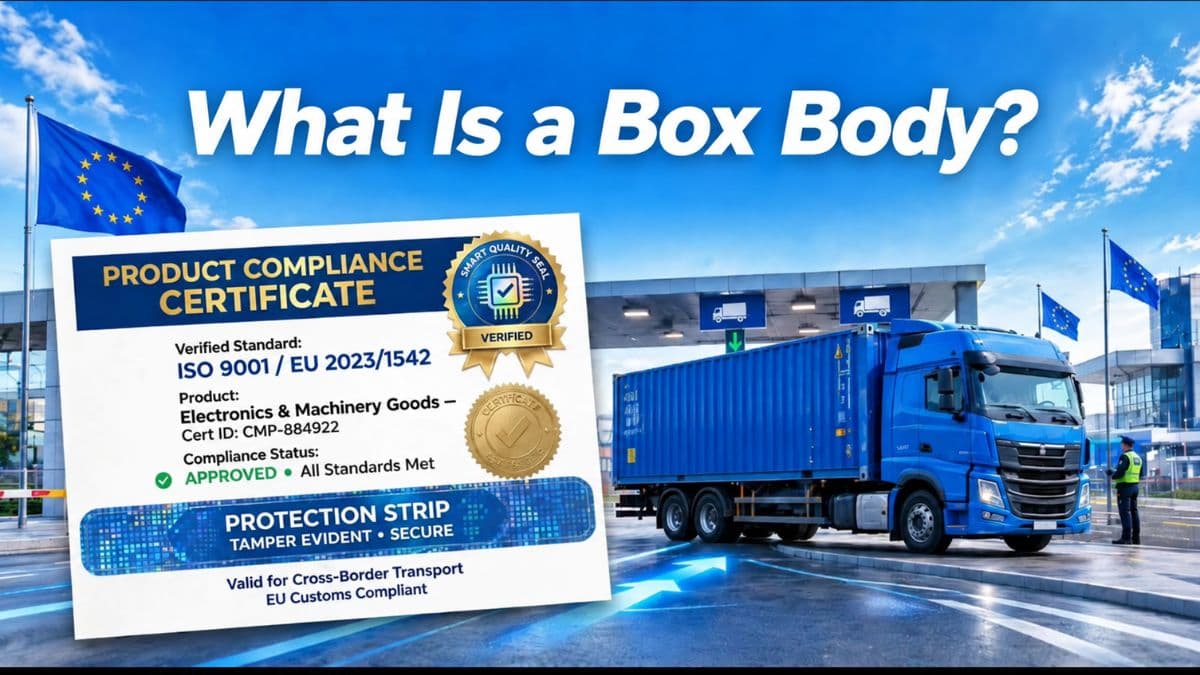
A box body is a rigid enclosed freight body with fixed metal walls, a sealed roof, and rear loading doors — mounted on a truck chassis or semi-trailer frame to carry goods requiring full protection from weather, theft, and contamination during road transport across Europe. Its cargo area has no openable sides and no exposed deck.
What Makes a Box Body Different from Other Freight Bodies?
A box body has two defining structural characteristics: fixed rigid walls with no lateral opening, and rear-only cargo access through hinged barn doors or a roller shutter. No other access point exists on the standard dry box body configuration.
A curtainsider trailer replaces fixed side walls with sliding PVC curtains that retract fully, allowing a forklift to enter from either side of the vehicle. A box body does not permit this — any forklift loading enters from the rear only, constrained to the width of the door aperture. A flatbed or open truck body carries no walls or roof, leaving the load exposed. The box body positions between these two: fully enclosed, single-access, weatherproof throughout transit.
Box body is also called hardside in European logistics shorthand, Kofferaufbau in German freight markets, and dry van in North American terminology. All three names describe the same structural fact: a rigid, dry, enclosed cargo space with no side access and no integrated temperature control. The Go Trans freight vehicle types glossary documents the full range of commercial vehicle body types and load unit classifications used across European road freight, covering rigid trucks, trailers, and specialist configurations.
What Materials Are Box Bodies Built From?
Steel, aluminium, and sandwich panel construction are the three material options for box body walls in European freight — each with different weight, payload, and thermal performance.
Steel box bodies carry the highest unladen weight and the lowest purchase cost. Steel walls resist impact from loading equipment and cargo movement inside the trailer, making steel the standard choice for general industrial freight, construction supplies, and mixed loads where body durability outweighs the benefit of saving weight. Lifespan on a steel body typically exceeds that of an equivalent aluminium structure.
Aluminium box bodies weigh 400 to 600 kg less than steel equivalents of the same floor length. Under the EU GVW limit, that difference is available as additional cargo payload on every loaded trip. Aluminium is the standard material on high-frequency retail and FMCG lanes where the payload gain over thousands of journeys compounds into meaningful cost differences.
Sandwich panel bodies use fibreglass-reinforced plastic or composite panels bonded over a foam core. They are lighter than steel and carry passive ambient insulation that plain metal walls do not — slowing the rate of temperature change inside the cargo area without an active cooling unit. These run on pharmaceutical ambient and food ambient distribution routes where maintaining a temperature band during transit is required without the cost and weight of a refrigerated system.
What Are the Standard Dimensions of a Box Body Semi-Trailer?
A standard European box body semi-trailer has an internal loading length of approximately 13.6 metres, a usable internal width of 2.45 to 2.48 metres, and an internal height of 2.60 to 2.70 metres in standard configuration — holding approximately 33 euro pallets in a single floor layer at a total volume of approximately 90 m³. Maximum payload on a 5-axle EU articulated combination reaches 24,000 to 26,000 kg under EU Directive 96/53/EC.
A mega box body semi-trailer achieves an internal cargo height of 2.90 to 3.00 metres through a lowered chassis — increasing total volume to approximately 100 m³ while keeping the same 13.6m loading length and standard external height.
Rigid box body trucks serve urban and regional distribution rather than long-haul lanes. A 26-tonne rigid carries 14,000 to 16,000 kg in an internal body of approximately 7 to 8 metres. An 18-tonne rigid carries 9,000 to 11,000 kg across a body of 6 to 7 metres internal length.
A swap body configuration mounts the same rigid enclosed box body on a folding-leg frame rather than a fixed chassis — allowing the body to be placed on rail wagons and short-sea vessels at intermodal terminals without unloading the cargo inside.
What Internal Fittings Does a Box Body Use for Cargo Securing?
Lashing rails, load bars, and dunnage bags are the three standard internal cargo restraint systems fitted in European box body trailers and trucks.
Lashing rails run horizontally along both internal side walls for the full length of the cargo area, at two or three heights from floor to upper wall. They accept hooks, rings, and ratchet strap anchors for tying pallets, crates, machinery, and packaged goods directly to the wall structure during transit.
Load bars are adjustable aluminium crossbars that slot into the lashing rail tracks and span the full internal width of the trailer. A bar placed immediately behind a pallet row creates a rigid transverse barrier that stops cargo from shifting forward during braking. Multiple bars at different heights form a three-dimensional restraint grid for mixed-profile loads.
Dunnage bags are inflated with compressed air and placed in the void spaces between pallets and loads. They block lateral movement in gaps that straps cannot span, preventing cargo-to-cargo contact damage during cornering and lane changes.
Garment hanging rails are longitudinal overhead tracks mounted in the roof frame. These carry clothing on hangers from collection point to delivery without folding, boxing, or repackaging at either end. Garment rails are fitted as standard on box body vehicles used in fashion and textile logistics across European distribution routes.
The cargo floor in a European box body semi-trailer is birch plywood or hardwood over steel cross-members, rated for forklift entry from the rear only. No side loading is structurally rated — the floor load specification applies to rear-entry equipment.
What Cargo Is a Box Body Used for in European Freight?
Electronics, pharmaceuticals, retail goods, fashion, and dangerous goods are the five primary cargo categories carried in box body vehicles across European road freight lanes.
Consumer electronics and technology products require full enclosure throughout multi-day cross-border transit — no exposed side panels, no risk of rain ingress through curtain gaps, and rear-door locking throughout the journey. Box body trailers are the default vehicle for electronics distribution across European retail networks where cargo security and arrival condition are shipper contractual requirements.
Pharmaceutical products at ambient temperature — including medicines, medical devices, and healthcare consumables — move in sandwich panel box bodies that hold the internal temperature band during transit without refrigeration. These lanes run between pharmaceutical manufacturing sites, warehouses, and hospital distribution networks across Europe.
Retail and FMCG stock covers packaged ambient food, cosmetics, cleaning products, housewares, and general consumer goods moving on fixed-schedule lanes between regional distribution centres and retail stores. Aluminium box bodies run these routes where loading the maximum legal payload on every journey justifies the higher body cost. The Go Trans logistics glossary covers freight vehicle classifications, cargo documentation, and European road freight terminology for shippers confirming the right transport specification before booking.
Fashion and textile logistics uses box bodies fitted with garment hanging rails — clothing travels from production facilities directly to retail on hangers, eliminating packaging and store-side rehanging at the delivery point.
Dangerous goods under ADR regulations travel in specifically certified box body variants with ventilation openings, non-sparking internal fittings, reinforced floor construction, and electrical systems meeting the ex-zone requirements for the specific ADR class on board. A standard dry box body without ADR certification cannot carry classified hazardous materials.
Box bodies are not suited to cargo requiring side forklift access at multi-drop stops — curtainsiders load and unload faster on those lanes. Machinery or structural cargo that cannot pass through rear doors needs a flatbed or low-loader. Cargo requiring active temperature control travels in refrigerated trailers rather than dry box bodies.
How Does Go Trans Arrange Freight in Box Body Vehicles?
Go Trans arranges full truckload transport across Europe through its carrier network, matching cargo weight, enclosure requirements, and delivery address to the right body type on each lane. Box body capacity suits consignments requiring full enclosure, rear-only loading, and protection from weather and theft throughout transit — electronics, pharmaceuticals, retail stock, and fashion goods moving on FTL and LTL European road freight lanes.
Frequently Asked Questions
What is the difference between a box body truck and a box body trailer?
A box body truck is a single rigid vehicle — the enclosed cargo body is permanently fixed to the chassis and cab as one unit that cannot be separated. A box body semi-trailer is a detachable trailer with its own rear axles and a kingpin coupling, towed by a separate tractor unit that can be uncoupled and exchanged at a depot or freight terminal. The trailer body remains when the tractor departs; the rigid truck always moves as a complete vehicle.
What is an ADR-certified box body?
An ADR-certified box body meets the construction requirements of the European Agreement on International Carriage of Dangerous Goods for road transport of hazardous materials. ADR box bodies have ventilation openings to prevent gas accumulation, non-sparking internal fittings and floor materials, reinforced structural elements, and electrical systems certified for the ex-zone class of the goods being carried. Standard dry box bodies do not hold ADR certification — the certification applies to the body's physical construction, not to the shipper's cargo declaration at the time of booking.
What is the difference between a box body and a refrigerated trailer?
A refrigerated trailer is a box body with insulated wall panels and an external active cooling unit that holds cargo temperatures from +12°C down to -25°C throughout transit. A dry box body has no insulation layer and no cooling equipment. The reefer's insulation panels reduce internal usable width and height by approximately 80 to 120 mm per wall face compared to a dry box body of the same external frame size, cutting usable load volume by 15 to 25 percent relative to an equivalent uninsulated body.
What is a double-deck box body trailer?
A double-deck box body trailer has a secondary internal floor system — folding or sliding rail frames fitted at mid-height — that creates a second pallet tier above the standard cargo floor. The additional tier raises euro pallet positions from approximately 33 to 66 for lightweight goods that can be stacked two levels high without exceeding the height of the internal cargo space. Double-deck box body trailers run in retail distribution, e-commerce fulfilment networks, and FMCG supply chains where cargo volume per trailer matters and load weight stays well below the payload ceiling.
What is the difference between a hardside and a curtainsider in European freight?
Hardside is the European logistics shorthand for a box body — a trailer or truck body with fixed rigid walls and rear barn door access only. A curtainsider replaces the fixed side walls with sliding PVC curtains that retract to allow forklift loading from either side of the vehicle. Hardsides suit electronics, pharmaceuticals, and high-value cargo requiring full enclosure and door-locked security. Curtainsiders suit palletised general cargo on multi-drop routes where speed of side access at each delivery point reduces overall route time.