
What Is a Semi-Trailer?
Discover semi-trailers, their structure, dimensions, body types, regulations, cargo uses, and importance in European road freight transport operations.
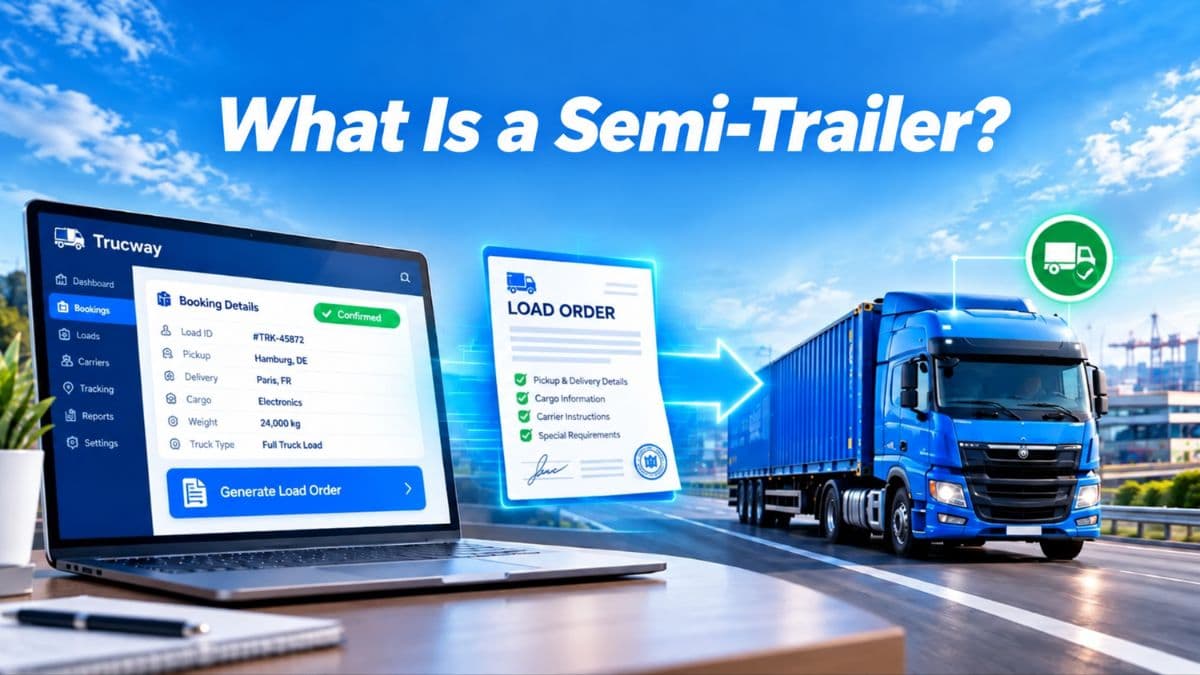
A semi-trailer is an unpowered trailer unit carried at the front by a tractor unit's fifth-wheel coupling and at the rear by two or three of its own axles, used to transport freight by road across Europe. Curtainsiders, flatbeds, refrigerated trailers, and low-loaders are all semi-trailer body types, and each serves a different cargo category in European road freight.
How Does a Semi-Trailer Work?
A semi-trailer attaches to a tractor unit through a kingpin fixed beneath the trailer's front section, which locks into a fifth-wheel plate mounted on the tractor's rear chassis. The tractor bears the weight of the trailer's front through this coupling while the trailer's own rear axles carry the load weight over the road.
When a tractor disconnects, the trailer's front section sits on retractable landing gear — two support legs that deploy during separation and hold the trailer level at loading bays, warehouses, and freight terminals. To reconnect, a driver reverses a tractor unit under the raised front of the trailer until the kingpin locks into the fifth wheel, then retracts the landing gear before moving.
This coupling design separates the semi-trailer truck — the full tractor-plus-trailer combination — from the semi-trailer itself, which is the unpowered trailer unit only. The distinction matters in freight booking: a shipper arranges capacity on the trailer; the tractor unit and driver are the carrier's assets.
The coupling method also makes drop-and-hook operations possible. A tractor drops a loaded trailer at a delivery point, picks up a pre-loaded trailer, and continues without waiting for the original shipment to be unloaded. On high-volume European freight lanes, this cuts terminal dwell time and reduces the cost of road freight per consignment.
What Are the Standard Dimensions of a Semi-Trailer in Europe?
Standard European semi-trailers have a loading length of 13.6 metres, an external width of 2.55 metres, and travel within a road network height clearance of 4.0 metres — the infrastructure standard applied at bridges and tunnels across most EU member states. These figures come from Council Directive 96/53/EC, the EU Weights and Dimensions Directive, which sets the maximum authorised dimensions for heavy-duty vehicles in international commercial transport across EU member states.
The full tractor-plus-semi-trailer combination reaches a maximum overall length of 18.75 metres, with 16.5 metres as the maximum for the trailer measured from kingpin to rear. The gross vehicle weight limit for a standard 5-axle articulated combination — a 3-axle tractor coupled to a 2-axle semi-trailer — is 40,000 kg for EU cross-border freight. Road-rail and road-sea intermodal operations qualify for a higher GVW of 44,000 kg under the same directive.
Payload capacity for most standard semi-trailer configurations runs between 24,000 and 26,000 kg, calculated by subtracting the combined tare weights of the tractor and trailer from the permitted GVW. Sweden, Finland, and Norway allow higher GVW combinations on domestic roads — in some configurations above 60,000 kg — but these revert to the standard EU 40,000 kg limit when crossing into other member states.
A mega semi-trailer achieves an internal cargo height of 3.0 metres through a lowered chassis profile, against 2.7 metres in a standard curtainsider. Both share the same 13.6m loading length and operate within the 4.0m external height restriction.
What Body Types Are Used on Semi-Trailers in European Freight?
The curtainsider is the most widely used semi-trailer body in European road freight — it has a rigid roof and floor with sliding PVC curtains on both sides, which allows forklift access from either side without rear-only restrictions. Curtainsiders carry palletised general cargo, packaged consumer goods, and mixed loads across European distribution lanes. Shippers researching trailer types and freight terminology before booking can use the Go Trans logistics glossary, which covers the vehicle types and freight terms common in European road transport.
Flatbed and platform semi-trailers have an open deck with no walls or roof. This allows crane, side-lift, and overhead loading for cargo that cannot pass through a closed trailer — steel coils, structural fabrications, long-section metal profiles, and construction machinery all move on flatbeds. Variants fitted with removable stanchions secure pipes, timber, and profiled steel sections that would otherwise require lashing to a plain deck.
Box body trailers, also called hardsides, have fixed rigid walls and a sealed roof with rear-door access only. Box bodies carry high-value goods, electronics, and pharmaceutical products where full enclosure is required throughout transit. They give better cargo security than a curtainsider but restrict loading to the rear.
Refrigerated semi-trailers — reefers — have insulated cargo walls and a built-in cooling unit that holds temperatures from +12°C down to -25°C depending on unit specification. Reefers move perishable food products, fresh produce, and temperature-sensitive pharmaceutical cargo on European cross-border routes where cold chain continuity is a regulatory and contractual requirement.
Low-loader semi-trailers have a loading platform between 0.4 and 0.9 metres above road level, which lets tall machinery, construction plant, and structural elements travel within the 4.0m height limit they would breach on a standard trailer. Low-loaders carry payloads of up to 60 tonnes depending on axle configuration.
Tanker semi-trailers carry liquids, gases, and bulk materials — fuels, chemicals, food-grade liquids, and industrial fluids — in corrosion-resistant tanks built and certified to the specific cargo class being transported. Further trailer and vehicle definitions sit in the road freight vehicle glossary.
What Is the Difference Between a Semi-Trailer and a Full Trailer?
A full trailer has both a front axle and rear axles, supporting its full weight independently from the towing vehicle. It connects to a tractor unit or rigid truck through a drawbar and ring coupling rather than a fifth-wheel. A semi-trailer has no front axle — the tractor carries the trailer's front weight through the kingpin and fifth-wheel connection, which is the structural reason it is called a semi-trailer.
Full trailers appear in road train combinations where a tractor pulls a semi-trailer with a full trailer coupled behind via drawbar — an A-train configuration common in Scandinavia and parts of Eastern Europe under national permit rules that allow longer overall vehicle combinations. Standard EU international freight runs on 5-axle articulated semi-trailer combinations, not road trains, under Directive 96/53/EC.
A rigid truck cannot tow a semi-trailer without a dolly converter unit that supports the trailer's front section in place of a fifth-wheel tractor. Semi-trailers are designed to work with fifth-wheel-equipped tractor units.
What Is the Difference Between a Semi-Trailer and a Swap Body?
A swap body is a detachable freight unit built for transfer between road vehicles, rail wagons, and short-sea vessels — it has no axles, no wheels, and no kingpin, and moves between transport modes using cranes, reach stackers, or specialist intermodal handling equipment. A semi-trailer operates on road only, with its own rear axles and a fixed kingpin coupling that requires a tractor unit to move.
Swap bodies are sized and fitted with corner castings for compatibility with European rail gauge and sea container crane systems. They are the standard load unit on intermodal freight corridors that combine road collection with rail trunk haulage or short-sea shipping. A semi-trailer's 13.6m loading length carries a larger road payload than a standard swap body, which makes semi-trailers the standard choice for full-load road freight operations without an intermodal leg.
What Industries Use Semi-Trailers for European Freight?
Retail and consumer goods distribution accounts for the largest share of curtainsider semi-trailer movements in Europe, with manufacturers and logistics operators running dedicated full-load lanes between production facilities and regional distribution centres on fixed weekly schedules.
Manufacturing companies move components, subassemblies, and finished goods by semi-trailer — curtainsiders for palletised parts, flatbeds for structural steel and fabricated metalwork, and car transporter variants for finished vehicles leaving production plants.
Food and beverage producers use refrigerated semi-trailers for perishable goods crossing European borders, where temperature chain continuity from loading to delivery is both a food safety obligation and a customer contract requirement.
Construction projects move steel fabrications, precast concrete sections, earthmoving equipment, and tower crane components on flatbed and low-loader semi-trailers, with special transport permits covering loads that exceed standard width or height limits.
Pharmaceutical manufacturers and healthcare distributors use GDP-compliant temperature-controlled reefers for medicinal products, vaccines, and cold-chain biologics moving between European production sites and national distribution hubs.
What Licence Is Required to Drive a Semi-Trailer in Europe?
Driving a tractor-plus-semi-trailer combination on European public roads requires a CE category driving licence — Klasse CE across EU member states — covering articulated combinations above 3,500 kg gross weight where the trailer exceeds 750 kg. Drivers must also hold a valid Certificate of Professional Competence under EU Directive 2003/59/EC, which requires 35 hours of periodic training completed within every five-year cycle.
Drivers carrying dangerous goods under ADR regulations need an additional ADR training certificate covering the specific class of goods on board. ADR certificates are road-transport specific and must be renewed every five years. Some ADR classes — including explosives and radioactive materials — require separate certificates from those covering flammable liquids or corrosive substances.
How Does Go Trans Arrange Semi-Trailer Freight Across Europe?
Go Trans arranges road freight across Europe using semi-trailer capacity through its carrier network, matching cargo weight, volume, and body type to the right trailer on each lane. Consignments that fill an entire trailer travel as full truckload freight across Europe — covering curtainsider, flatbed, and refrigerated semi-trailer options on point-to-point routes between European origins and destinations. Consignments that do not fill a trailer travel as part-load freight arrangements, where pallet positions or weight-based space within a semi-trailer are booked from a consolidated shipment schedule.
Frequently Asked Questions
What is the maximum payload of a semi-trailer in European international freight?
The standard payload for a semi-trailer in EU international freight runs between 24,000 and 26,000 kg for a 5-axle articulated combination at the 40,000 kg GVW limit set by Council Directive 96/53/EC. Tractor unit unladen weight and trailer tare weight both reduce available payload — the combined total of tractor, trailer, and cargo must stay within the permitted GVW on each route.
Can a semi-trailer cross EU member state borders without special permits?
A semi-trailer that meets EU Directive 96/53/EC dimension and weight limits circulates freely across EU member state borders for international commercial freight without additional permits. Combinations above standard limits — including oversized cargo on low-loader or flatbed semi-trailers — require special transport authorisation from each country's road authority before departure, and some oversize routes require escort vehicles under national regulations.
What is the difference between a mega trailer and a standard semi-trailer in Europe?
A mega semi-trailer has an internal cargo height of 3.0 metres, achieved through a lowered chassis profile, compared to 2.7 metres in a standard curtainsider. Both use the same 13.6m loading length and travel within the 4.0m external height limit. Mega trailers suit European distribution lanes where tall palletised goods, racked products, or large consumer appliances cannot fit within the headroom of a standard trailer.
What is drop-and-hook in semi-trailer freight operations?
Drop-and-hook is a trailer exchange method in which a tractor unit uncouples from a loaded semi-trailer at a delivery or staging terminal and immediately couples to a pre-loaded trailer for the next leg. The semi-trailer's landing gear holds the front section stable while uncoupled. On high-frequency European freight corridors, drop-and-hook eliminates tractor waiting time during loading and unloading, reducing the cost of operating dedicated road freight lanes.
What cargo falls outside the capacity of a standard curtainsider semi-trailer?
Cargo exceeding 4.0 metres in height, 2.55 metres in width, or 26,000 kg in payload falls outside the limits of a standard curtainsider and requires a specialist body type. Oversized machinery needs a low-loader, crane-loaded structural cargo needs a flatbed, temperature-sensitive goods need a reefer, and liquids or bulk materials need a certified tanker semi-trailer. Loads exceeding standard dimensions also require special transport permits before the journey starts.