
What Is an In-Loader?
Explore in-loaders, their ground-level loading system, cargo applications, height advantages, trailer differences, and role in specialist European road freight logistics.
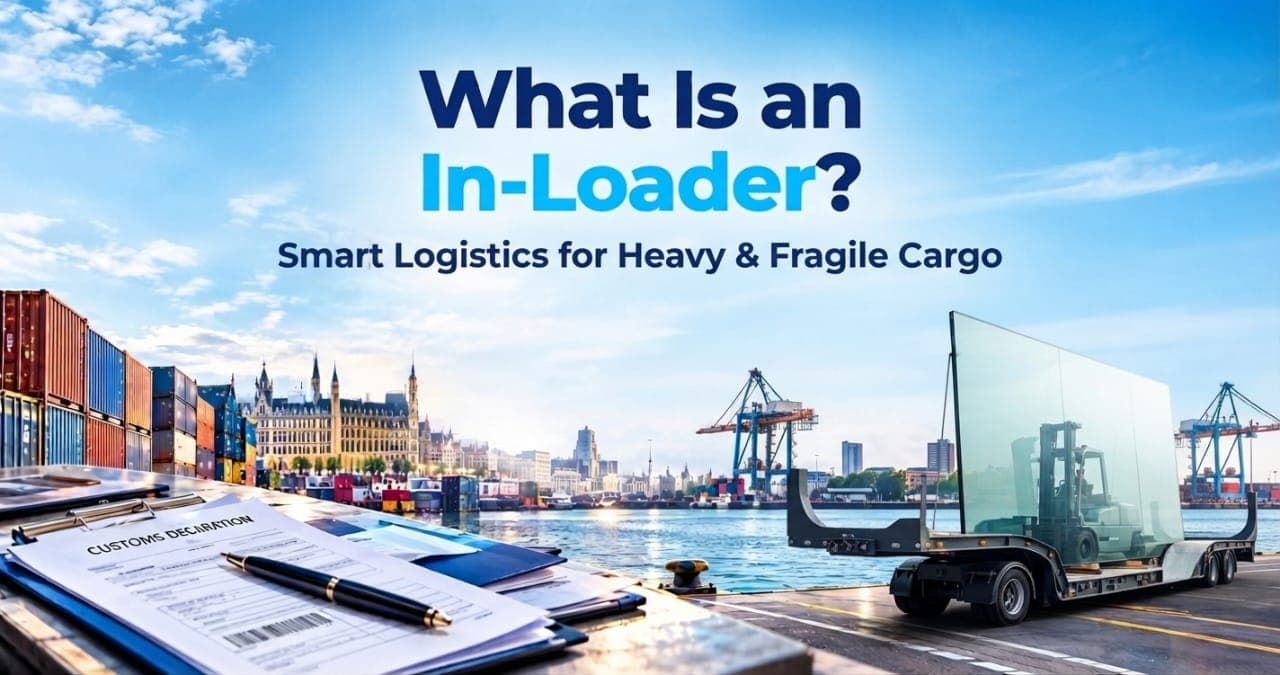
An in-loader is a specialist semi-trailer without continuous through-axles — individual wheel suspension on each side lets the trailer frame drop hydraulically to ground level, so tall cargo sits in the open well between the wheel arches instead of being raised above a standard platform. It is the default road freight vehicle for tall vertically loaded cargo across European construction and glazing supply chains.
How Does an In-Loader Work?
An in-loader lowers its frame to ground level by retracting individual wheel assemblies on both sides — with no through-axles spanning the width of the trailer, the central frame section descends without obstruction. The driver triggers the hydraulic system, the frame drops, and flat steel or concrete transport pallets — called inloader flats or Innenlader-Paletten — settle into the well at ground level for loading.
Wall panels, glass sheets, and prefabricated building elements load standing upright onto these flats directly from the ground, without crane assistance or overhead lifting equipment. Once the load is secured, the hydraulic system raises the frame to road height and the air suspension holds the configuration for transit. The term Flatliner — the standard name used across German and Austrian freight markets for this vehicle — comes from these flat pallets that form the cargo base inside the lowered well. In-loaders belong to the specialist body type range within the road freight vehicle glossary classification, alongside curtainsiders, low-loaders, flatbeds, and box body trailers operating on European road freight lanes.
What Is the Key Advantage of the In-Loader Over a Standard Trailer?
An in-loader carries wall panels, glass sheets, and prefabricated building elements within the 4.0 metre total height ceiling of EU Directive 96/53/EC without triggering an abnormal load permit, escort vehicle requirement, or special route authorisation. Elements standing upright on inloader flats in the lowered well reach a total vehicle height of approximately 3.70 metres — inside the legal limit for standard road travel.
A semi-trailer carries cargo on a raised platform. A wall panel standing at 2.5 metres on an open truck trailer plus a platform height of approximately 1.0 metre places the total combination at 3.5 metres — with under 0.5 metres remaining before the legal ceiling. An in-loader eliminates the platform beneath the cargo entirely, redirecting that height into the wheel-well space. The operational outcome is straightforward: no permit costs, no convoy delays, no restricted route planning, and standard motorway speed on European roads. EU road dimension standards for articulated vehicle combinations — including the 4.0m height limit and 2.55m width threshold — are documented in the Go Trans European freight terminology as part of the European commercial vehicle classification framework.
What Cargo Does an In-Loader Carry?
Precast concrete wall panels, large-format glass sheets, prefabricated timber building elements, and tall structural steel fabrications are the four primary cargo types transported on in-loaders across European road freight lanes.
Precast concrete wall elements leave production facilities standing upright on Innenlader-Paletten and travel directly to construction sites, where a tower crane lifts them off the trailer at the point of installation. Glass panels for architectural and industrial glazing projects ride on A-frame carriers that hold the sheets vertically throughout transit — glass inloader pallets rated to payloads of up to 32,000 kg are the standard certified load carrier for this cargo category.
Prefabricated timber wall sections produced at offsite construction facilities and large flat structural steel plates or sections also move on in-loaders whenever their standing height exceeds the margin available on a standard raised platform trailer.
In-loaders are not the right vehicle for standard palletised freight, horizontally loaded machinery, or any cargo that gains no height clearance benefit from the lowered frame position.
What Is the Difference Between an In-Loader and a Low-Loader?
A low-loader trailer has a fixed depressed deck between the front gooseneck and the rear bogie axles — cargo rests on a surface that sits closer to the road than a standard trailer platform, while an in-loader has no central platform at all, with the cargo occupying the wheel-well space that the absence of through-axles creates.
A low-loader suits heavy horizontal loads — construction plant, site machinery, large vehicles — where the requirement is weight capacity and ground clearance for rolling or craning equipment onto a bearing surface. Cargo still rests on a platform; that platform is simply lower. An in-loader suits tall vertical loads — wall panels, glass sheets — where the requirement is headroom created by removing the platform beneath the cargo rather than just positioning it lower. Both vehicles address the same road height limit through different structural mechanisms built for different cargo profiles.
What Is the Difference Between a Flatliner and a Flexliner?
Flatliner is the single-deck in-loader — the standard road configuration for tall vertically loaded cargo on European highways. One loading tier, one layer of inloader flats, one consignment of standing elements per trip.
Flexliner is the Doppelstock-Innenlader — a double-deck in-loader with a second loading tier above the first, raising pallet capacity to approximately 54 euro pallets or 87 roll containers per trip. Langendorf stated at Transport Logistic 2025 that two Flexliner trains can replace three conventional articulated trucks on distribution lanes, with up to 40% CO₂ reduction against equivalent conventional trailer movements. These figures are Langendorf manufacturer claims.
The Flatliner is a specialist construction and glazing logistics vehicle built for height clearance. The Flexliner is a high-volume distribution efficiency vehicle built for cargo density on general freight lanes. Individual wheel suspension is the shared structural feature; cargo type and operational purpose differ between the two.
How Does Go Trans Arrange Specialist Freight Using In-Loader Capacity?
Go Trans arranges full load freight from Belgium through its carrier network, matching cargo standing height, dimensions, and delivery address to the right vehicle type on each lane. Tall precast concrete wall panels, large architectural glass consignments, and prefabricated building components that exceed the height envelope of standard curtainsider or flatbed equipment are matched to specialist vehicle capacity through Go Trans's freight carrier network.
Frequently Asked Questions
What does Innenlader mean in English?
Innenlader is the German logistics term for in-loader — a specialist semi-trailer in European road freight whose cargo sits inside the lowered well between the wheel arches rather than above a raised platform. The word translates directly as "inner loader." In English-language freight markets, particularly in Austria and German-speaking logistics sectors, the same vehicle is most commonly referred to as a Flatliner — a name that comes from the flat concrete pallets used as the cargo base inside the lowered frame section.
What are inloader flats?
Inloader flats — Innenlader-Paletten in German — are the flat steel or concrete load carrier platforms that sit inside the lowered well of an in-loader, forming the floor on which wall panels and glass sheets stand during road transit. They are structurally separate from the trailer and can be pre-loaded at the factory or production site before the vehicle arrives, allowing cargo preparation to run independently of truck scheduling and reducing dwell time at the loading point.
What is the load capacity of an in-loader trailer?
Standard in-loader trailers carry payloads of approximately 20,000 to 24,000 kg depending on configuration and axle specification. Glass inloader pallets used for large-format architectural glass are statically certified to a payload capacity of up to 32,000 kg per load carrier unit. The gross vehicle weight of the tractor-trailer combination stays within the EU 40-tonne limit on standard road networks under EU Directive 96/53/EC, with higher limits applying on specific Scandinavian and Baltic routes under national derogations.
What industries use in-loaders regularly in European road freight?
Precast concrete panel manufacturing, architectural and industrial glass production, timber frame offsite building construction, and structural steel fabrication are the four sectors that use in-loaders as a standard vehicle in their outbound logistics. Each sector produces tall vertically oriented elements — wall panels, glass sheets, timber cassettes, steel frames — that exceed the 4.0m road height limit when loaded on a standard raised trailer platform, making in-loaders the default transport solution for their outbound supply chains.
Who manufactures in-loader trailers in Europe?
Faymonville and Langendorf are the two principal European manufacturers of in-loader trailer systems. Faymonville produces the PREFAMAX telescopic in-loader range, with a loading length that adjusts between 9.5 and 13.4 metres to accommodate different element sizes from the same production batch. Langendorf manufactures the Flexliner SDT double-deck in-loader for high-frequency general freight distribution lanes. Both manufacturers' trailer systems are compatible with inloader flat pallets supplied by specialist load carrier manufacturers including R-TECH.