
What is a Tarpaulin Sprinter?
Learn about tarpaulin sprinters, including vehicle types, dimensions, payload limits, side-loading benefits, cargo suitability, and European van delivery applications.
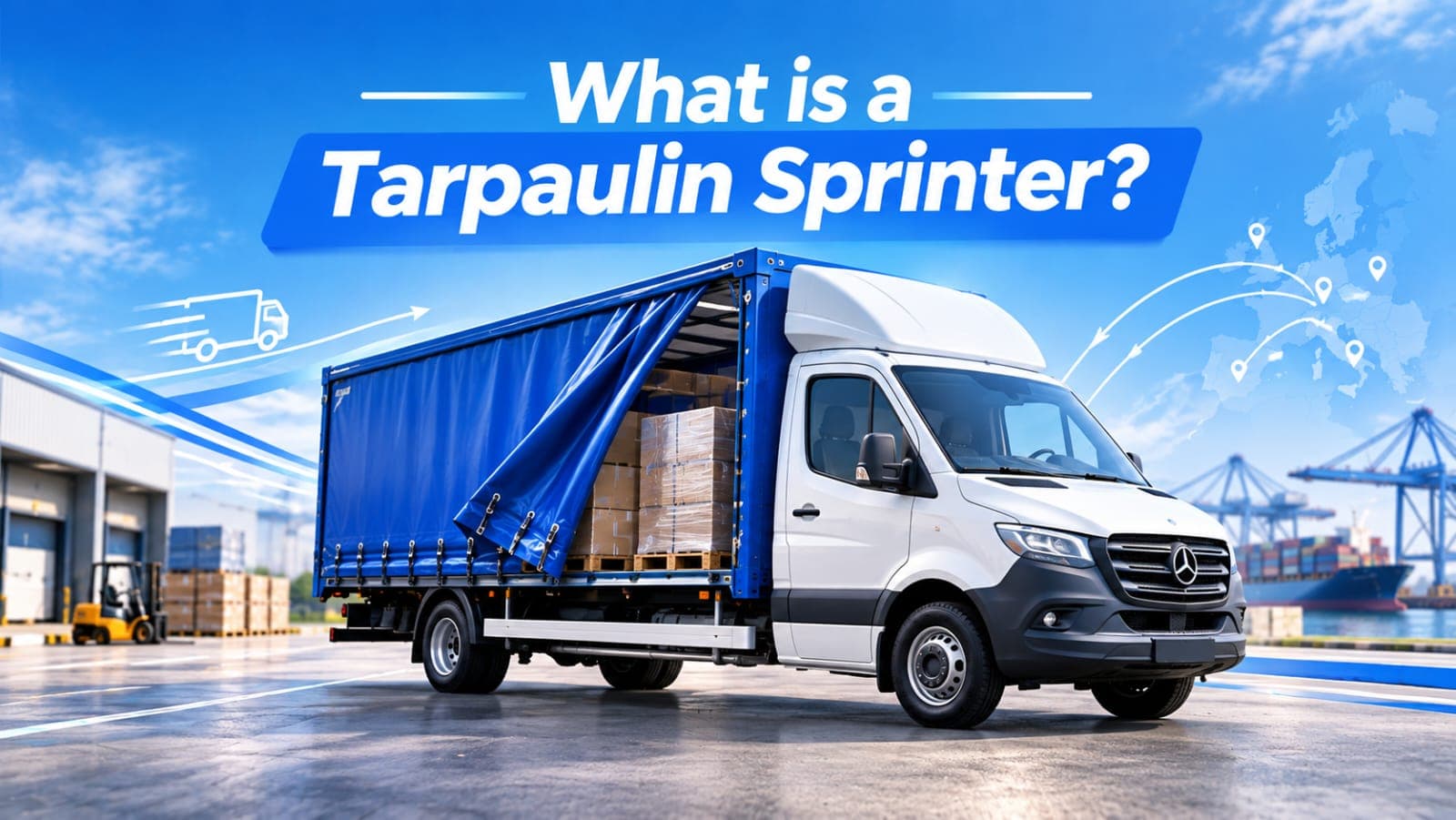
A tarpaulin sprinter is a light commercial vehicle in the 3.5-tonne category fitted with a tarpaulin or curtain-sided body that slides open along both sides for direct forklift or crane access to the load area. The body replaces the rigid sidewalls of a standard closed panel van. Standard tarpaulin sprinters carry 2–3 Euro pallets with a net payload of 900–1,200 kg.
What vehicles are used as a tarpaulin sprinter?
The tarpaulin sprinter is built on a standard light commercial vehicle platform — most commonly the Mercedes-Benz Sprinter, but also the Ford Transit, Volkswagen Crafter, Iveco Daily, and Fiat Ducato — all in the 3,500 kg GVW category.
The Mercedes-Benz Sprinter is the most widely deployed LCV platform in European road freight — the name has become a generic descriptor for the full 3,500 kg curtain-sided van category across the logistics industry, regardless of which manufacturer built the base vehicle. A tarpaulin sprinter belongs to the LCV category within the broader truck and trailer types taxonomy used in European road freight — the same framework that covers panel vans, tautliner semi-trailers, and full truckload vehicles.
All tarpaulin sprinters share one regulatory boundary: 3,500 kg GVW places them within the EU Category B driving licence. A driver with a standard car licence can operate a tarpaulin sprinter without any additional truck licence category — making it the largest curtain-sided vehicle accessible to the full courier network driver pool.
The curtain body is a specialist conversion applied to the platform cab chassis. Mercedes-Benz and the other major LCV manufacturers offer factory-approved conversion programs through certified bodybuilders — the cab and engine remain standard while a tarpaulin frame body replaces the closed panel van cargo section behind the cab.
How does a tarpaulin sprinter work?
A tarpaulin sprinter is built on a platform cab chassis — the cab and engine are factory-standard, and a tarpaulin frame body sits on the load area behind the cab in place of a standard box body.
The roof is a fixed rigid structure supported by a front headboard and a rear frame. Side curtains are sliding PVC-coated tarpaulin panels running on top and bottom rails — they open fully from the rear of the body toward the front cab end, clearing the entire load floor on each side. Vertical aluminium stanchions give the curtain its shape and pivot or are removed to allow forklift access along the full vehicle side.
Standard hinged doors at the rear provide a third loading point. When the curtains are closed for road transit, load restraint straps and buckles tension the tarpaulin against the stanchion frame — keeping cargo secure and the curtain aerodynamically stable.
A tautliner applies this same curtain-and-stanchion mechanism at full semi-trailer scale — 13.6 metres, 33 Euro pallets, and 24,000 kg net payload. A tarpaulin sprinter applies the same principle at LCV scale — 3.0–4.3 metre body, 2–3 Euro pallets, and 900–1,200 kg net payload.
What are the dimensions and payload of a tarpaulin sprinter?
A standard tarpaulin sprinter on a 3,500 kg GVW platform has an internal body length of 3.0–4.3 metres depending on wheelbase, an internal width of 1.8–2.0 metres, and a net payload of 900–1,200 kg.
| Dimension / Capacity | Standard Wheelbase | Long Wheelbase |
|---|---|---|
| GVW | 3,500 kg | 3,500 kg |
| Net payload | 900–1,000 kg | 1,000–1,200 kg |
| Internal body length | 3.0–3.5 m | 3.5–4.3 m |
| Internal width | 1.8–2.0 m | 1.8–2.0 m |
| Euro pallet capacity | 2 pallets | 2–3 pallets |
| EU driving licence | Category B | Category B |
The 3,500 kg GVW ceiling is the boundary between the EU Category B car licence and the Category C truck licence. A tarpaulin sprinter is the largest curtain-sided vehicle that remains within Category B — which is why it runs throughout courier and distribution networks where the driver pool holds Category B licences only.
What cargo is a tarpaulin sprinter suited to?
A tarpaulin sprinter is suited to urgent small pallet consignments, industrial samples, automotive components, construction supplies, and any load requiring side access that fits within 1,200 kg and 2–3 Euro pallets.
Industries that regularly use tarpaulin sprinters include manufacturing — automotive parts, spare components, and production replenishment where a single or double pallet must reach an assembly line the same day — and construction, where long profile materials such as aluminium sections, steel bars, and timber lengths require side or crane loading rather than rear-only access through a box body door. Event logistics and trade show operations also deploy tarpaulin sprinters for display equipment and modular stand components that need side-loading at exhibition venues.
A tarpaulin sprinter is not suited to temperature-controlled cargo — a refrigerated van handles that requirement. Loads above 1,200 kg or requiring more than 3 Euro pallets move to a larger dedicated van or a panel van configuration, depending on whether side access or enclosed protection is the priority.
What is the difference between a tarpaulin sprinter and a standard panel van?
A tarpaulin sprinter opens fully along both sides for forklift or crane access — a standard panel van loads only through the rear doors, restricting access to cargo stored forward of the rear opening.
On a standard panel van, the rigid box body means the rear door is the only entry point. Any cargo positioned forward of the last item loaded cannot be reached without unloading everything behind it first. A tarpaulin sprinter eliminates that constraint — the curtain slides clear and any pallet position on the load floor is directly accessible from either side without disturbing other cargo.
The trade-off is protection. A rigid panel van provides hard-sided security, tamper evidence, and structural protection for fragile goods. The tarpaulin curtain does not provide the same barrier. For loads requiring hard-sided security or where the vehicle sits unattended in an open location, a closed panel van is the correct choice.
How does Go Trans use tarpaulin sprinters?
Go Trans arranges dedicated van transport for urgent smaller consignments and dedicated point-to-point loads through carrier partners — tarpaulin sprinters fall within the van delivery service category for loads requiring side access at LCV scale. For loads exceeding 1,200 kg or 2–3 Euro pallets, Go Trans arranges pallet delivery or LTL freight through the same carrier network on the appropriate vehicle type. Further vehicle types and freight terminology are covered across the glossary of logistics terms.
Frequently Asked Questions
Does driving a tarpaulin sprinter require a special licence?
No Category C (truck) or C1 (medium truck) licence is required to operate a tarpaulin sprinter at 3,500 kg GVW — the standard EU Category B car licence covers it. This licence boundary makes the tarpaulin sprinter the largest curtain-sided freight vehicle accessible to the full courier network driver pool without additional training or certification, which explains its deployment across last-mile and regional distribution operations throughout Europe.
What is the driving licence difference between a tarpaulin sprinter and a tautliner?
A tautliner requires a Category CE driving licence — the full articulated vehicle licence — because the tractor unit pulling the semi-trailer exceeds 3,500 kg GVW. A tarpaulin sprinter at 3,500 kg GVW falls within the Category B car licence. Both use a curtain-and-stanchion side-opening system, but the licence requirement and load capacity place them in entirely different operational and regulatory categories.
When should I use a tarpaulin sprinter instead of a standard panel van?
Use a tarpaulin sprinter when the load requires side access — long items such as aluminium profiles, steel bars, or timber sections that cannot be loaded rear-first into a box body, or when a forklift must access the load from the side rather than through the rear doors. If the load fits within 1,200 kg and 2–3 Euro pallets and the collection or delivery point has forklift side access, the tarpaulin sprinter is the correct vehicle. If the load is hand-loaded or requires hard-sided tamper evidence, a standard closed panel van is the more practical choice.